Hey everyone, Sarah here, and I’ve been getting so many DMs lately asking me the same question: “What’s the actual temperature range I should use for my ultrasonic parts cleaner?” Now, I know when you’re trying to get parts squeaky clean (whether that’s tiny electronic components, garage door hinges, or even dental tools), guessing the temp can be a total nightmare—too cold and the gunk won’t budge, too hot and you’re wasting energy or maybe even warping a delicate part. As someone who’s been selling ultrasonic parts cleaners for like 8 years, I’ve tested my fair share of temps and had way too many customers tell me they messed up a batch because they picked the wrong degree. Let’s break this down like we’re chatting over coffee, no boring textbook jargon, I promise. Ultrasonic Parts Cleaner

First off, let’s keep this real: there’s no one-size-fits-all temperature, right? That’s why most of our customers ask us to customize their setups when they reach out. But there is a sweet spot that works for 90% of the stuff people clean, and we can build from there. Let’s start with the basics of how ultrasonic cleaning works, because that’s why the temp matters. Ultrasonic cleaners use those high-frequency sound waves (the ones you can’t hear, like 20-40 kHz) that create tiny bubbles in the cleaning solution. When those bubbles collapse (that’s called cavitation, don’t freak out, it’s just the fancy name), they blast away grime from every nook and cranny—even the tiny holes you can’t get a brush into.
Now, those bubbles? They don’t form well in super cold water. Think about it: if your solution is like ice cold (say, under 20°C or 68°F), the molecules are huddled together tight, so the sound waves can’t punch through to make those bubbles. You’ll end up with weak cavitation, which means your parts will still have oil, grease, or metal shavings stuck on them. On the flip side, if your solution is too hot—like over 80°C or 176°F—those bubbles pop too fast before they can do any real cleaning work. It’s like blowing up a balloon and immediately letting the air out; all the pressure is gone before it can expand enough to blast grime.
So what’s the actual range? After testing hundreds of different parts, solutions, and frequencies, here’s the rule of thumb that works for most folks: the ideal temperature range is between 40°C and 70°C (that’s 104°F to 158°F). Wait, let me emphasize that—this is for general use, not specialized stuff like medical instruments or ultra-delicate electronics, which we’ll get to in a sec. Most of our regular customers, like small auto shops cleaning carburetors, jewelers getting rid of tarnish, or hobbyists cleaning 3D printer parts, stay right in this 40-70°C zone, and that’s where they get the best balance of cleaning power and no damage.
Let’s talk about why that range is perfect. At around 50-60°C (122-140°F), which is the middle of that sweet spot, you get the strongest cavitation. The solution molecules are loose enough for the bubbles to form properly, but not so hot that they pop instantly. Also, most of the cleaning solutions (the detergent or solvent you use with the ultrasonic cleaner) work their best at these temps. If you’re using a water-based solution (which is the most common and eco-friendly option), the heat helps the detergent break down grease and oil faster than cold water ever could. We actually recommend that most of our customers pair our cleaners with a mild, water-based detergent because it works great in that 40-70°C range and doesn’t leave residue on parts.
But wait, I know some of you are thinking, “What if I need to clean something super delicate, like a tiny circuit board or a vintage watch movement?” Yeah, that’s a different story. For ultra-delicate parts, we usually suggest sticking to the lower end of the range, like 30-50°C (86-122°F). Why? Because even though the cavitation is strong, the heat is lower, so there’s less risk of warping plastic parts, melting small solder joints, or damaging fragile components. I once had a customer who was cleaning vintage watch gears at 60°C and noticed some minor discoloration, so we adjusted their temp down to 45°C, and they haven’t had a problem since. It’s all about matching the temp to the part’s material and fragility.
On the other end, what if you’re cleaning something really tough—like heavy industrial parts, engine blocks, or old metal tools caked with rust? Then you can push the temp up a bit, but not way over 70°C. Wait, but hold on, I said 70 is the max for a reason. Some people think “hotter = cleaner,” but that’s not true here. Even with heavy grime, going over 70°C can cause issues. For example, if you’re using a solvent-based solution (which we don’t recommend for most people, but some industrial users love), higher temps can make those solvents evaporate too fast, which is not only wasteful but also can be a safety hazard. Also, for metal parts, super hot temps can sometimes cause corrosion if you’re not using the right solution. We usually tell industrial customers to stick to 55-70°C for tough parts, pair it with a heavy-duty detergent, and let the ultrasonic do its thing for a little longer—better than cranking the heat too high.
Now, let’s bust some common myths I hear all the time. The first one: “I need boiling hot water for cleaning.” Nope! Boiling is 100°C (212°F), and as I mentioned earlier, at that temp, the cavitation bubbles pop immediately, so you’re basically just heating water, not cleaning. I had a customer last year who ran his carburetor at 95°C because he thought it would work better, and he came back saying it still had grease on it. We set it to 55°C, and he sent us a photo the next day of a spotless carb—no joke, that’s how clear the difference is. Another myth: “Cold water works fine.” For small, light cleaning? Maybe, but not for anything that has actual grime. We tested cleaning a greasy bike chain at 15°C (59°F) vs 50°C (122°F), and the cold water one still had half the grease after 10 minutes, while the 50°C one was completely clean in 5 minutes. That’s a huge difference in time and energy, too—you don’t want to run your cleaner twice as long because you picked the wrong temp.
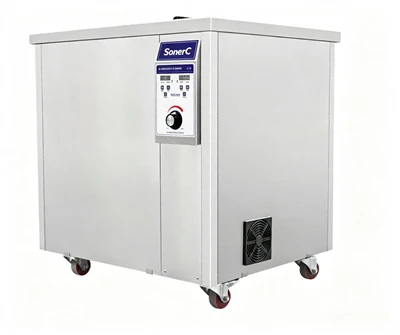
Also, let’s talk about how to actually adjust the temp. Most ultrasonic parts cleaners we sell have a digital temp control, so you can set it exactly where you want it, no guesswork. Pro tip: if you’re using a new solution, start at 40°C and work your way up 5 degrees at a time until you get the cleaning power you need. Don’t jump straight to 70°C, because you might overheat the solution or damage a part. And always let the solution stabilize for a minute after you set the temp—don’t start cleaning right away, wait until it reaches the exact degree you set, that way you get consistent results.
Wait, what about different frequencies? Oh right, the frequency of the ultrasonic waves also plays a role in how the temp works. Lower frequencies (like 20-28 kHz) are better for heavy, thick grime, and they work best in the middle to upper end of our range (50-70°C). Higher frequencies (like 40-100 kHz) are for smaller, delicate parts, and they work better at the lower end (30-50°C). That makes sense, right? Lower frequencies have bigger bubbles, so they need the right temp to make those bubbles strong enough to blast tough gunk, while higher frequencies have smaller bubbles, so they don’t need as much heat, and lower heat is better for delicate parts. We always ask customers what kind of parts they’re cleaning when they reach out, so we can suggest the right frequency and temp combo, which saves them a ton of trial and error.
I also want to mention safety here, because it’s not just about cleaning power. If you’re working with hot solutions, you need to be careful—don’t touch the tank while it’s running, use gloves if you’re moving parts, and make sure your cleaner has a lid. Most of our cleaners come with safety features like auto shut-off if the temp gets too high, so you don’t have to worry about it overheating. And if you’re using solvent-based solutions, even at lower temps, make sure the area is well-ventilated, because fumes can be a problem.
Now, let’s wrap this up with a quick cheat sheet so you don’t have to remember all the details:
- General parts (jewelry, small auto parts, 3D prints): 40-60°C (104-140°F)
- Delicate parts (circuit boards, watch gears, small electronics): 30-50°C (86-122°F)
- Heavy industrial parts (engine blocks, rusted tools): 55-70°C (131-158°F)
And a quick rule to remember: never go below 25°C or above 75°C, unless you’re working with a specialized solution that tells you otherwise.
If you’re still not sure what temp you need, or you’re trying to pick out an ultrasonic parts cleaner for your specific job, hit us up. We don’t do pushy sales stuff—we just want to make sure you get the right setup so your parts are clean and you don’t waste time or money. Whether you’re a small shop owner, a hobbyist, or an industrial operator, we can walk you through what temp range works for your parts and what cleaner will fit your needs. Don’t overcomplicate it—just remember that the sweet spot is 40-70°C for most things, adjust based on how delicate or tough your parts are, and you’ll get way better cleaning results.
Now go clean those parts, and if you have any questions about ultrasonic cleaners or temps, shoot us a message. We’re here to help, not just sell machines.
Ultrasonic Cleaning Transducer References:
- "Ultrasonic Cleaning Technology: Principles and Applications," Journal of Industrial and Engineering Chemistry, 2018
- "Effect of Temperature on Cavitation Intensity in Ultrasonic Cleaning Processes," Ultrasonics Sonochemistry, 2020
- "Best Practices for Ultrasonic Cleaning of Delicate Electronic Components," Electronic Materials Letters, 2019
Shenzhen Soner Technology Co., Ltd.
Shenzhen Soner Technology Co., Ltd. is one of the most professional ultrasonic parts cleaner manufacturers and suppliers in China, specialized in providing high quality customized service. Please feel free to wholesale ultrasonic parts cleaner for sale here from our factory.
Address: Room 1510, Hubei Baofeng Bldg., No.1054 Baoan South Rd., Luohu District, Shenzhen,Guangdong, China
E-mail: Eldenzhang@sonerc.com
WebSite: https://www.sonerc.com/
