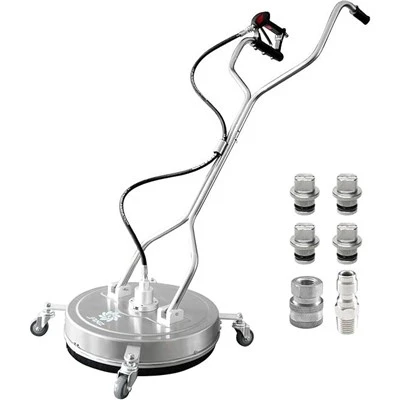
If you’ve ever stared at a dried coffee ring on your office tile, a year-old grease stain on your workshop concrete, or a set-in grass stain on your patio brick and thought “nothing will lift this,” I get it. For the last seven years, I’ve spent most of my days talking to homeowners, janitorial teams, and commercial facility managers who’ve wasted hundreds of dollars on off-the-shelf cleaners, paper towels, and elbow grease that just don’t cut through stubborn set-in stains. As someone who works in surface cleaner design and supply— I’ve tested and tweaked every part of how these machines and their cleaning solutions interact with tough grime— I’m here to break down exactly how a surface cleaner works on those stains that feel like they’re permanent, no fancy jargon, and no sales pitch that feels like a hard sell. Let’s start with what most people get wrong: stubborn stains aren’t just “dirt.” They’re biological, chemical, or organic messes that have bonded to the tiny, uneven craters of nearly every surface— tile grout, concrete, vinyl, even polished wood. Over time, oils in coffee or motor grease oxidize (that’s the same thing that makes an apple turn brown), turning them hard, sticky, and impossible to wipe away with a regular rag or even a standard mop. That’s where surface cleaners come in, and their power isn’t just about the pressure of water spraying— it’s a three-step process that works because we engineer every part of the machine to target how those stains bond to surfaces. First, the pre-treatment stage that most people skip (and why it’s actually non-negotiable for set-in stains). A lot of folks grab a surface cleaner and immediately blast at a stain with hot water, but that’s the fastest way to push the stain deeper into tiny crevices instead of lifting it. The right surface cleaner system doesn’t just spray water— it mixes a cleaning solution tailored to the stain type before that water hits the surface. For example, a grease stain on concrete needs an alkaline solution (think pH level 10 to 12, neutral is 7) that breaks down the molecular bonds between oil molecules and the concrete’s porous surface. A coffee or wine stain on tile grout, though, needs an acidic solution (pH 4 to 6) to eat through the tannins that have set. What makes our surface cleaners different from a garden hose pressure washer is that we integrate that solution mixing right into the unit, so the water hits the stain pre-mixed, not just plain hot water that does nothing but steam the stain into the grout. Once the solution has had 30 seconds to two minutes to work (another thing most people miss— you can’t blast a stain the second you spray it), the second step: controlled pressure and surface agitation, which is the part people usually see but don’t understand. A standard pressure washer might blast water at 3,000 PSI or more, but that’s way too powerful for most surfaces— it can etch tile, crack concrete, or even strip the seal off wood. Our surface cleaners operate at 1,200 to 2,000 PSI, calibrated to match how deep a stubborn stain has bonded. But even more important than the pressure number is the design of the cleaning head. Unlike a pressure washer’s wand that sprays water in a wide, uneven fan, a surface cleaner has a round, enclosed head with two rotating nozzles that spin at high speed, spraying water and solution in a tight, circular pattern that never lifts off the surface. That agitation does two things at once: it breaks up the remaining molecular bonds the solution didn’t get, and it scrubs the stain out of those tiny craters where mops or rags can’t reach. I remember a job last year with a restaurant owner who had three months of baked-on fryer grease on their patio concrete— they’d tried a industrial degreaser and a pressure washer, but the grease was still there. We used one of our mid-sized surface cleaners, let the alkaline solution dwell for 90 seconds, then ran the spinning head over the stain three times. When we rinsed it, the grease was gone, and there was no etch mark on the concrete, like the high-pressure wand had left. The third, often overlooked step in how a surface cleaner works is the vacuum or recovery system that’s built right in. Here’s the biggest mistake anyone can make after cleaning a stain: leaving the loosened grime and solution sitting on the surface. If you don’t pick it up immediately, the tiny particles of lifted stain dry back into the surface, turning what was just loosened into a new set-in stain. Our surface cleaners aren’t just sprayers— the enclosed head has a built-in vacuum that sucks up the dirty solution, grease, or stain residue the second it’s been agitated, leaving the surface almost dry by the time you pass the machine. That’s why you’ll hear facility managers say surface cleaners get “a deeper clean” than pressure washers— they don’t just move the stain around, they actually remove it entirely. Now, I know what you’re thinking: “What about surfaces that aren’t concrete or tile? I have a wooden patio, or vinyl siding, or even a marble floor with a wine stain.” Great question— because surface cleaners work differently on porous vs non-porous surfaces, which is why we design different models for each. Non-porous surfaces like sealed tile, marble, or vinyl have a smooth finish, so stains sit on top, not inside. For these, our gentler surface cleaners run at 800 to 1,000 PSI, with a low-agitation head that won’t scratch the seal, and a vacuum that pulls the stain before it has time to seep. For porous surfaces like unsealed concrete, patio brick, or wood, the process shifts a little: the solution is formulated to penetrate the tiny pores without seeping deeper, the pressure is a touch higher to get into those pores, and the vacuum has a higher suction power to pull the dissolved stain out. I’ve spent a lot of time testing this— last winter, a customer had a sealed marble entryway with a red wine stain from a holiday party. They tried rubbing alcohol, baking soda, even a professional cleaner, but the stain was still visible. We used our small, marble-specific surface cleaner, mixed a mild, pH-neutral solution for stone, let it dwell for 60 seconds, then ran the head over the stain once. The vacuum pulled all the wine and solution up, and the stain was gone— no damage to the marble polish, because we matched the machine’s specs to the surface. What’s funny is how many people assume surface cleaners are only for commercial spaces or big jobs. I’ve seen homeowners buy a basic model for their garage floor, which has years of oil stains from car repairs, or their patio, which has grass and berry stains from summer cookouts. The same science applies, just scaled down. Now, let’s talk about the science behind why this works, not just the process— because it’s not magic, it’s molecular science. Stubborn stains are held to surfaces by intermolecular forces: weak van der Waals forces, hydrogen bonds, or in the case of grease, non-polar bonds that don’t mix with water. A good cleaning solution alters the polarity of those bonds— for example, alkaline solutions break the non-polar bonds in grease, turning them into molecules that mix with water. The agitation from the surface cleaner’s spinning nozzles adds mechanical energy that breaks the remaining weak bonds, while the vacuum removes the now-water-soluble stain particles before they can re-bond to the surface. That’s why a surface cleaner is way more effective than just a bucket of soapy water and a scrub brush— the combination of chemical action, calibrated mechanical agitation, and immediate removal of dissolved stain doesn’t leave a chance for re-bonding. I don’t work in marketing, and I don’t do flashy demos with big logos. What I do is answer calls at 7 a.m. from construction crews who need to remove concrete mix stains from sidewalks before a municipal inspection, and evening calls from moms who spilled tomato sauce on their patio awnings and can’t get it out. Last month, I got a message from a school janitor who used one of our surface cleaners to remove 10-year-old crayon stains from hallway tile grout— he said he’d spent $2,000 on professional scrubbing machines that couldn’t get the crayon out, but our unit did it in 20 minutes. That’s the kind of result that doesn’t come from a fancy ad, it comes from understanding exactly how surfaces and stains interact, and building machines that work with that science, not against it. If you’ve got a stubborn stain that’s been driving you crazy— whether it’s at home, in a commercial space, or on a job site— and you want to talk about how our surface cleaners can get rid of it without damaging your surface, reach out to our team to discuss your specific project and find the right solution for your needs. Surface Cleaner
High Pressure Washer Gun REFERENCES
Kissa, E. (2001). The Science of Cleaning Agents. Marcel Dekker.
Surface Preparation and Cleaning for Concrete (2019). International Concrete Repair Institute.
Stone Care and Maintenance Handbook (2020). Natural Stone Institute.
Zhejiang GTM Hi-Tech Intelligent Equipment Co., Ltd.
As one of the most professional surface cleaner manufacturers and suppliers in China, we also support customized service. With abundant experience, we warmly welcome you to buy discount surface cleaner for sale here from our factory. For price consultation, contact us.
Address: No.5 of Changjiang Road, 2nd Economic Development Zone of Wenling, Zhejiang, China
E-mail: yehuanting1@hongyemfg.com
WebSite: https://www.gtm-plungerpump.com/
